


A full mobile money wallet is a strange kind of problem. The money you are expecting is real, the customer is ready to pay, and yet the transaction can fail because there is nowhere left to put it. For anyone who has had to make a withdrawal just to create room for an incoming payment, the old 2 million FCFA ceiling could feel very small indeed.
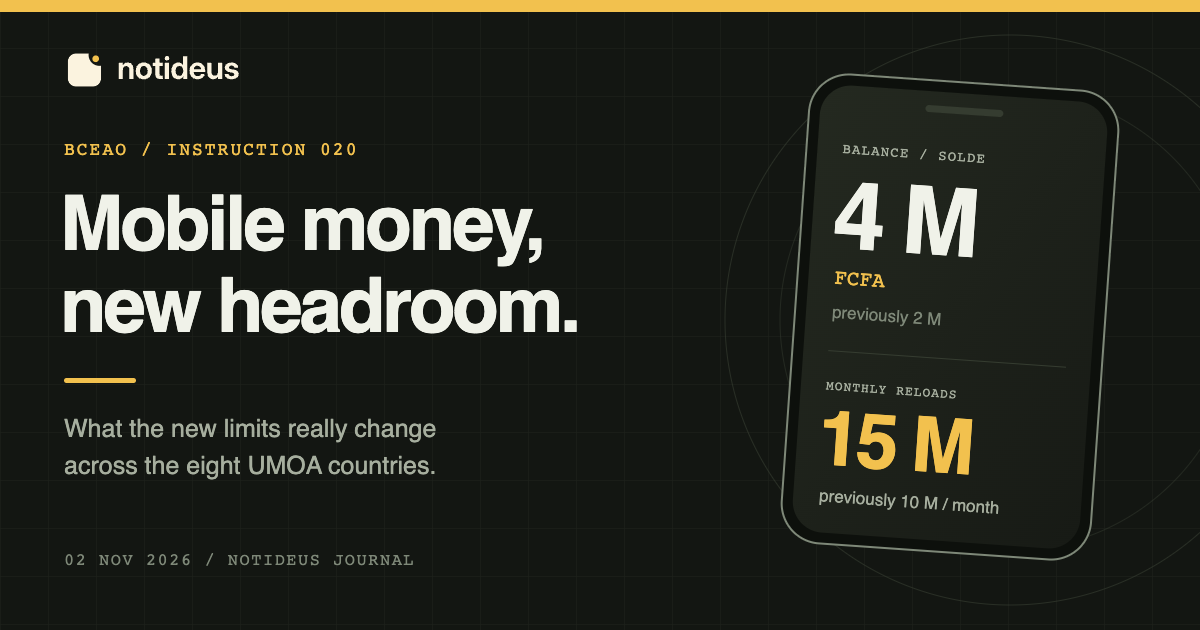
Since 2 November 2026, there is more breathing room. The standard ceiling for an identified customer’s electronic-money balance has doubled to 4 million FCFA, while cumulative monthly reloads can now reach 15 million FCFA, up from 10 million.
That much is true. The shorter version travelling through social media — “you can now receive 15 million every month” — is a little too quick, though. The legal text is more specific, and the details matter.
The change, in plain language
The new rules come from Instruction No. 020 of 8 October 2026, issued by the Banque Centrale des États de l’Afrique de l’Ouest (BCEAO). It amends the 2015 framework governing electronic-money issuers and replaces its Articles 31 and 34.
| What is capped | Before 2 November | Since 2 November | Change |
|---|---|---|---|
| Total balance held by an identified customer with one issuer | 2 million FCFA | 4 million FCFA | +100% |
| Cumulative reloads by one customer in one month with one issuer | 10 million FCFA | 15 million FCFA | +50% |
| Minimum share of outstanding e-money backing held as demand deposits | 75% | 65% | −10 percentage points |
The first two rows affect customers directly. The third belongs to the plumbing behind the service; we will come back to it.
Two conditions in the first row deserve to be underlined: identified and with one issuer. This is not a fresh 4 million allowance for every phone number, SIM card or wallet app.
If one customer has several electronic-money instruments issued by the same institution, their balances are added together. A wallet holding 2.5 million and another holding 1.5 million at that same issuer already reach the 4 million ceiling. A separate account with a genuinely different issuer is a separate calculation.
That distinction is easy to miss when “account”, “number” and “operator” are used interchangeably in everyday conversation.
No, 15 million is not a single-transfer allowance
The second number is about rechargements — reloads — accumulated over a month. It is not the maximum size of one transfer, and it should not be casually translated into a universal ceiling on every kind of incoming payment.
The original 2015 instruction describes loading and reloading against cash or scriptural money. The new text keeps that specific vocabulary. It does not say that every person-to-person transfer, merchant payment, salary payment and cash deposit suddenly shares one indistinguishable “inflow” bucket.
This is not word-splitting. It changes the practical question to ask your provider. Rather than “Can I receive 15 million?”, ask:
- Which operations count as reloads on my account?
- What per-transaction and daily limits still apply?
- How do you aggregate several wallets held with the same issuer?
- Has the new ceiling already been applied to my customer profile and channel?
The BCEAO sets the regulatory outer boundary. Operators can still have their own transaction limits, contractual conditions, risk controls and product rules. An app’s error message or an old FAQ page may also take time to catch up with a new regulation.
What changes in real life
For a household, the higher balance ceiling mostly means fewer forced withdrawals. Money set aside for rent, school fees, a family ceremony or a large purchase can remain in the wallet for longer without hitting the old 2 million wall.
For a freelancer or small trader, the difference can be operational. A larger customer payment no longer automatically requires splitting the transaction or making an early trip to an agent. Someone who receives several payments in a short period has more room to manage the timing of withdrawals.
The monthly reload increase is less dramatic in percentage terms — 50% rather than 100% — but potentially just as useful for businesses with regular cash-to-wallet activity. Fifteen million spread across a month is not the same thing as fifteen million held at once: the balance and reload limits still have to be considered separately.
There is also an important exception for professionals. The ceilings do not apply to distributors or acceptors of electronic money when they are acting in their professional capacity. An acceptor is, broadly, a provider of goods or services that accepts electronic money as payment.
That does not mean every informal shopkeeper’s personal wallet magically becomes unlimited. The wording points to the professional role defined by the framework. A business handling meaningful volumes should use the appropriate merchant or distribution arrangement with its provider, keep personal and business activity clearly separated, and document the relationship properly.
Above the limit is possible, but not automatic
The new ceilings are standard ceilings, not an absolute wall. An issuer can ask the BCEAO for prior authorisation to exceed them.
The request must explain why the exception is needed, how long it should last, the amount involved and the strengthened controls in place. Those controls include transaction monitoring, risk management and operational oversight. The central bank can attach conditions, limit the duration or withdraw the authorisation if the justification disappears.
In other words, the process belongs to the issuer, not to a customer who simply taps “increase my limit” in an app. Businesses with recurring needs above the standard thresholds should speak to their provider well before a large payment is due.
The quieter change: how customer money is backed
The amendment also changes what issuers must do with the funds backing electronic money in circulation.
Those assets can be held as demand deposits or term deposits with banks or microfinance institutions, and as certain eligible debt securities issued or guaranteed by public authorities, regional financial institutions or companies listed on the regional stock exchange. At least 65% of the outstanding electronic-money balance must now remain in demand deposits at all times. The previous minimum was 75%.
The intention is easy to understand: enough of the backing must stay readily available for customers to redeem their electronic money, while issuers get a little more flexibility over how the remainder is held. Securities are counted at the lower of acquisition cost and market value, a prudent way to avoid flattering the numbers when prices move.
This is not a customer-facing interest rate or a promise of investment returns. It is a liquidity and risk-management rule behind the wallet.
Why now
Mobile money is no longer a side channel for small transfers. According to BCEAO figures reported by EcoMatin, electronic-money transactions in the UMOA region reached 219,151 billion FCFA in 2025, across 16.37 billion operations. Côte d’Ivoire accounted for 71,307 billion FCFA, or 32.5% of the regional value.
The same report counts 284.8 million open electronic-money accounts at the end of 2025, of which 92.7 million were active. Those are accounts, not unique people — another aggregation detail worth keeping in mind — but the scale is unmistakable.
A ceiling designed in 2015 was always likely to meet a different reality once wallets became part of everyday commerce, payroll and business collections.
Ivory Coast, yes — but not Ivory Coast alone
This is a UMOA-wide reform, not an Ivory Coast-only offer. It applies to the eight member states: Benin, Burkina Faso, Côte d’Ivoire, Guinea-Bissau, Mali, Niger, Senegal and Togo.
It does not automatically extend to every West African country. Ghana, Nigeria, Liberia and Guinea, for example, have their own regulators and rules. “West Africa doubles mobile money limits” would therefore be too broad; “the eight UMOA countries” is the accurate version.
More room does not mean less caution
A wallet that can hold twice as much can also expose twice as much to a lost phone, a compromised PIN, a SIM-swap attack or a moment of inattention. The basics still do the heavy lifting: protect the PIN, verify the recipient and amount before confirming, use the official application or USSD code, and treat unsolicited support calls with suspicion.
It is also worth remembering that electronic-money issuers are not permitted to pay interest on funds received in exchange for electronic units under the unchanged Article 5 of the 2015 framework. A larger ceiling creates flexibility; it does not turn the wallet into an interest-bearing savings account.
The best way to read this reform is neither as a revolution nor as a minor technical footnote. It removes a constraint that had become awkward for real users, while keeping identification, monitoring and liquidity safeguards in place. For many people, the change will be wonderfully uneventful: a payment that would once have bounced simply goes through.
And for anyone moving serious volumes, this is the right week to read the provider’s updated terms rather than relying on a screenshot with two large numbers on it.